Design for forming, not machining
Draft angle, depth-to-width ratio, corner radius, draw ratio and material thinning should be reviewed early. Small design changes can improve release, wall consistency and trim repeatability.
Formed parts without heavy tooling
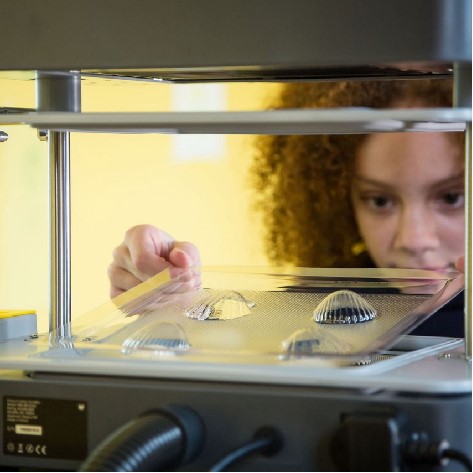
Vacuum forming turns a heated plastic sheet into a dimensional tray, cover, housing or packaging component. It offers a practical balance of tooling cost, part size and production speed for many low-to-medium volume projects.
Project logic
Draft angle, depth-to-width ratio, corner radius, draw ratio and material thinning should be reviewed early. Small design changes can improve release, wall consistency and trim repeatability.
Prototype and production tools serve different volume, finish and cooling needs. We choose the tool route around expected quantity, part size, cosmetic requirements and change risk.
After forming, the part must be trimmed, drilled or routed to its final interface. Trim datums and inspection points should be defined with the forming tool rather than treated as a separate afterthought.
Applications
Common questions
Thermoforming is the broader process family. Vacuum forming uses vacuum pressure to pull heated sheet over or into a mold; pressure forming adds pressure for sharper detail.
Often yes. Tooling can be simpler than injection molding, making it useful for prototypes, bridge production and many lower-volume programs.
A STEP file or dimensioned drawing is preferred. Include material, thickness, annual volume, appearance surfaces and trim features when available.